How to Balance the Metal Element in Feng Shui
Learn how to balance Metal in feng shui with colors, shapes, support elements, room checks, and reflective layout guidance.
To balance the Metal element in Feng Shui, do not simply add more silver, gray, or round objects. First decide whether the room needs more clarity and structure, less coldness, or better support from the surrounding elements. Then adjust color, shape, material, lighting, and function together.
Metal is associated with clarity, precision, completion, and refinement. In a room, those qualities can feel clean and focused. Too much Metal, though, can feel cold, sharp, or rigid. Too little can make a space feel visually noisy and unfocused.
Start With a Room Audit
Before buying decor, stand in the room and ask what the space already does. A kitchen with stainless appliances may already carry strong Metal cues. A soft, plant-heavy studio may need one clear Metal anchor. A white minimalist office may need warmth more than another silver object.
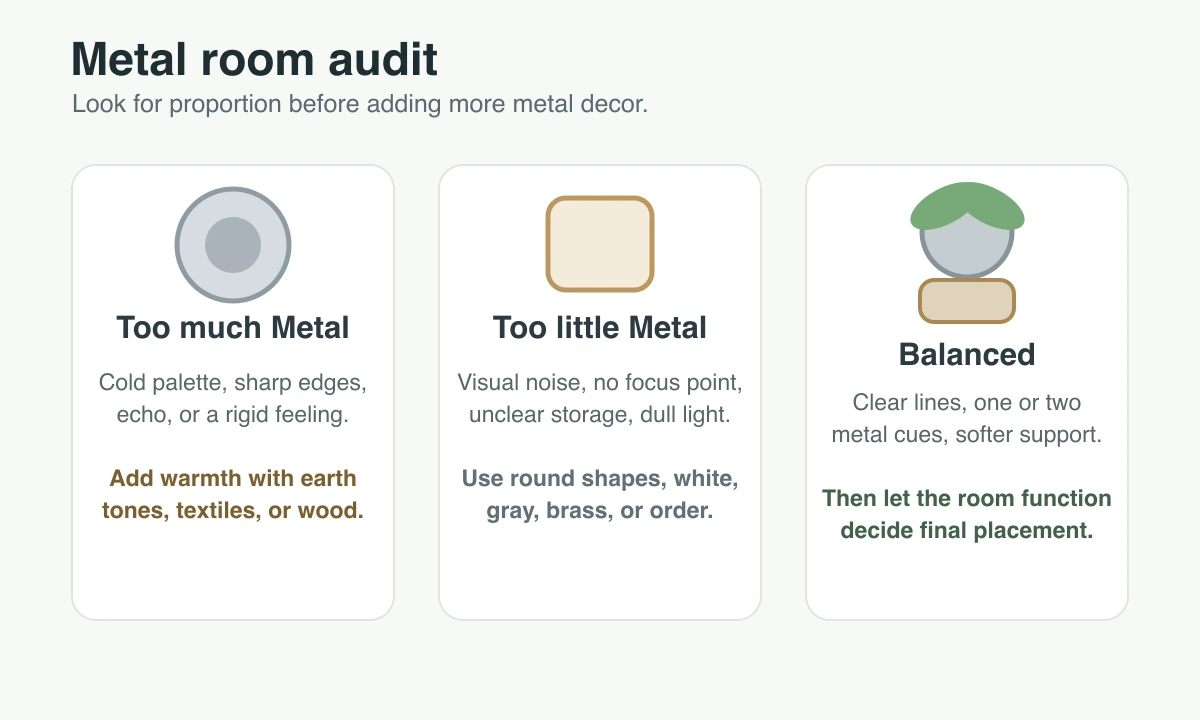
| Room signal | Metal is likely | First adjustment |
|---|---|---|
| Clear lines, round objects, white or gray palette | Present and useful | Keep it simple and avoid over-layering |
| Cold, echoing, sharp, or sterile feeling | Too strong | Add Earth tones, textile warmth, or soft Wood |
| Cluttered surfaces and no visual focus | Too weak | Add one round shape, metal finish, or ordered storage |
| Many metallic objects but little comfort | Unbalanced | Reduce shine and add grounding materials |
This is why the FateFolio wiki page on Five Elements in Feng Shui is helpful background, but not the whole answer. A practical room audit has to read the actual space.
Use Metal Cues With Restraint
Metal cues include white, gray, silver, gold, brass, circular shapes, arches, clean lines, and polished or refined materials. You can use them in lamps, frames, bowls, mirrors, hardware, round tables, white storage, or a single sculptural object.
Good Metal balancing usually uses one or two clear signals rather than many small metallic decorations. The goal is clarity, not clutter. A brass lamp plus a round tray may be enough. A wall of shiny objects may overwhelm the room.
Use these practical checks:
- Can your eye find one calm focal point?
- Are surfaces easier to read after the change?
- Does the room feel cleaner without feeling colder?
- Are sharp or reflective objects softened by fabric, plants, or earth tones?
Support Metal With the Element Cycle
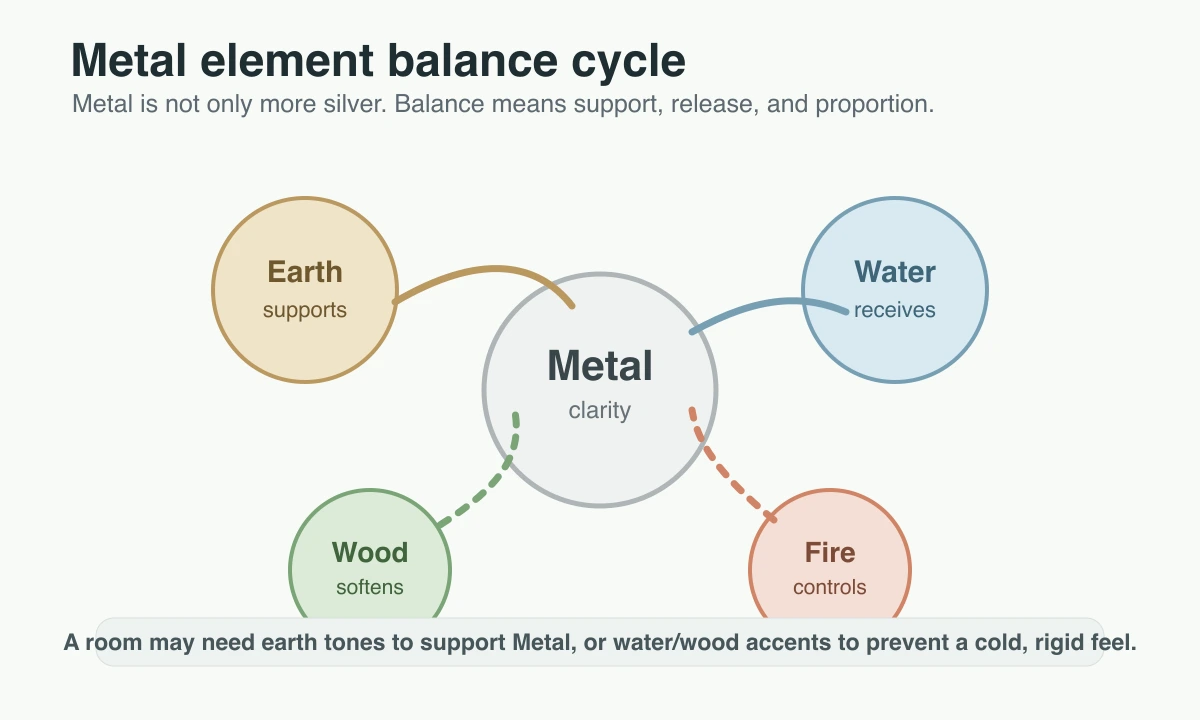
In Five Elements thinking, Earth supports Metal, Metal supports Water, Fire controls Metal, and Wood can soften a rigid Metal feeling through contrast. That does not mean every room needs all five elements equally. It means you can choose a balancing move based on the room's current mood.
| If the room feels | Try this | Why it helps |
|---|---|---|
| Too cold or strict | Add ceramic, stone, beige, ochre, or clay tones | Earth support makes Metal feel grounded |
| Too flat or dull | Add one refined Metal object or round form | Metal creates focus and definition |
| Too shiny or hard | Add soft plants, fabric, or wood grain | Wood and texture reduce the rigid feeling |
| Too dry or static | Add a small dark accent or gentle reflective surface | Water-related cues can soften and release |
For the broader theory, compare the Five Elements and Element Balance wiki pages. Those entries explain the system; this article turns the idea into a room-level workflow.
Balance Metal by Room Type
In an office, Metal can support focus. Use one round lamp, a clean filing system, a white surface, or a brass detail. Avoid making the desk feel clinical.
In a bedroom, keep Metal gentle. Soft white, a round mirror placed with care, or a small metal frame can work, but too many hard surfaces can disturb rest. If the room feels cool, add Earth-toned bedding or warm lighting.
In a living room, Metal can make a space feel composed. Use it to define one area, such as a reading corner, shelf, or coffee table. Then balance it with texture, plants, or warm ceramics so guests do not experience the room as stiff.
In a kitchen, Metal may already be strong because of appliances, sinks, utensils, and bright surfaces. Add Earth or Wood support before adding more metallic decor.
Common Mistakes
The first mistake is treating Metal as a literal material only. In Feng Shui, Metal also appears through shape, color, order, and mood. A white curved cabinet may carry more Metal feeling than a tiny silver charm.
The second mistake is over-correcting. If a room feels chaotic, you may need one strong Metal cue and better storage. If you add many gray objects at once, the space can become colder without becoming calmer.
The third mistake is ignoring function. A bedroom, office, and entryway need different expressions of Metal. Balance is not a fixed formula; it is a relationship between the room, the people using it, and the purpose of the space.
How FateFolio Fits
If you want to review Metal as part of a larger spatial pattern, use FateFolio's home Feng Shui map reading. It can help you think through direction, surroundings, and layout as a whole instead of isolating one element.
FateFolio Feng Shui
Review your room with Feng Shui context
Use FateFolio to reflect on home layout, direction, qi flow, and element balance in one place.
For general concepts, the Feng Shui wiki guide is the better starting point. For this specific task, keep returning to the room audit: what does the space already express, and what would make it clearer without making it colder?
Final Takeaway
Balancing the Metal element in Feng Shui means creating clarity with proportion. Add Metal when a room needs focus. Support it with Earth when it feels weak. Soften it when the room becomes cold or rigid. The best result is not a room full of metal objects, but a space that feels clear, steady, and usable.

About the editor
FateFolio Editorial
FateFolio Editorial
FateFolio Editorial writes plain-language notes on Bazi, I Ching, Feng Shui, readings, and timing—with the reasoning and limits kept in view.
Related posts
Feng Shui Colors Guide for Rooms and Elements
Learn Feng Shui colors by Five Elements, room purpose, Bagua context, and practical ways to choose color without fixed luck claims.
Feng Shui Door Color Guide for Front Entries
Choose a Feng Shui door color by facing direction, Five Elements, entry condition, and practical home context without fixed luck claims.
Feng Shui And Bed Placement Guide
Learn how to place a bed with door visibility, wall support, window checks, and balanced sides before using a Feng Shui home reading.