
Free Auspicious Date Selection Online
Auspicious Date Selection
Enter your event and date range to get 3-5 recommended dates, reasoning, and planning notes.
Use the shortlist for planning alongside venues, people, logistics, and real-world constraints.

What You'll Get from Auspicious Date Selection
Review the date options, reasons, and cautions together.
Lucky Date Options
Multiple auspicious date choices with priority ranking and suggested time windows.
Reasoning & Cautions
Why each date is recommended, plus what to watch out for based on Chinese calendar.
Practical Notes
Actionable reminders to make your planning easier to execute.
Structured Report
Save to local history and revisit when coordinating details.
Start Free Auspicious Date Selection
Choose the event, date range, and timezone to generate lucky date options.
Build a date shortlist you can actually use
Choose the event and a workable range before comparing symbolic date preferences. Venue availability, participants and practical deadlines still belong in the decision.
Set the event, range and timezone
Select the event and check the timezone. Choose today or a future start date and a later end date; the range can span up to 90 days. An optional description can explain the occasion and its constraints.
Wedding, engagement and betrothal-gift events also require both people’s birth dates. A non-marriage event uses the event and date range without those partner fields.
Compare the reasons, not just the rank
The service builds candidate dates with stem-branch labels, Day Officers, lunar-mansion labels, reference scores, reasons and cautions. It then explains a ranked shortlist and dates to treat cautiously, with hour suggestions where available.
Keep the date, reason and timezone together when comparing options. A lower-ranked but workable date may suit your real constraints better than an unavailable higher-ranked one.
Illustrative shortlist: scheduling a move
Imagine that two reference dates suit a moving event, but only the second has an available moving company and enough preparation time. Comparing the symbolic reasons with those practical constraints gives you a usable shortlist.
No dates have been calculated for this example. It demonstrates how to read a shortlist; it does not declare a real day auspicious or promise an easier move.
A favorable reference is not an outcome guarantee
Calendar scores are traditional reference rankings, not probabilities of success. Do not delay necessary care, ignore contract deadlines or compromise safety to match a date. Hour suggestions must be read in the selected timezone.
What Auspicious Date Selection Is Good For
Useful for comparing options and coordinating real-world constraints.
Wedding & Engagement
Find multiple auspicious wedding dates for coordinating family and venues.
Moving & House Warming
Get a clear shortlist of lucky moving dates with do/don't reminders.
Business Opening
Suggested auspicious dates and risk notes for smoother business launches.
Travel Planning
A shortlist of favorable travel dates to help you plan around constraints.
How Auspicious Date Selection Works
Pick Event & Range
Keeping the range within ~3 months helps keep results readable.
Generate Options
We output multiple auspicious date candidates with priorities and reasoning.
Decide with Context
Balance timing with real constraints—people, venues, and process.
How to Use This Shortlist
Date selection supports planning; execution still depends on the real arrangement.
Privacy-first: inputs are used only for this run; nothing is saved by default.
The shortlist is for planning support, not a command to use one specific date.
Structured output you can save to local history for later comparison.
What is Auspicious Date Selection?
Auspicious date selection (择日, Zeri) is an ancient Chinese practice of choosing favorable dates for important life events. Based on the Chinese lunar calendar and traditional almanac (黄历, Huangli), this practice has been used for thousands of years to plan weddings, business openings, moving, and other significant occasions.
The Chinese calendar incorporates complex calculations involving the lunar cycle, solar terms, heavenly stems, earthly branches, and various auspicious and inauspicious factors. Each day has specific qualities that make it more or less suitable for different activities.
Our free auspicious date selection tool uses these traditional principles to help you find lucky dates for your important events—providing multiple options with clear reasoning so you can make informed decisions.
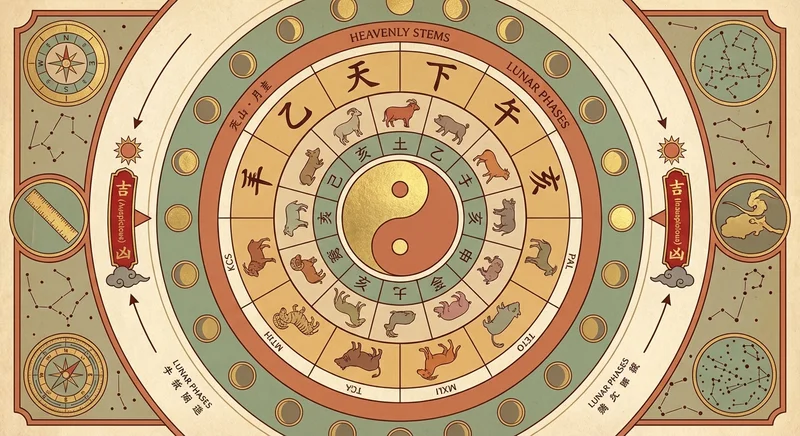

How Chinese Calendar Date Selection Works
Our auspicious date selection tool analyzes the Chinese calendar to identify favorable dates for your specific event. We consider factors like the Twelve Day Officers (建除十二神), auspicious and inauspicious stars, and traditional compatibility rules.
The tool provides multiple date options ranked by suitability, with reasoning for each recommendation so you can compare them.
The tool also highlights concerns and planning notes. Auspicious date selection is one input; preparation and execution still matter.
Whether you're planning a wedding, moving to a new home, starting a business, or scheduling an important trip, our free tool helps you find dates that align with traditional Chinese calendar wisdom.
Auspicious Date Selection FAQ
Better inputs lead to better shortlists.
Is a larger date range better for finding auspicious dates?
+
Can you tell me the single best auspicious day?
+
Does location/timezone matter for date selection?
+
Why multiple auspicious date options instead of one answer?
+
Will auspicious date selection guarantee success?
+
Combine Timing with Other Tools
Try Divination for momentum, Bazi for themes, and Feng Shui for environment.