Feng Shui Money Tree Placement Guide
Learn where to place a feng shui money tree, what to avoid, and how to connect wealth symbolism with real room conditions.
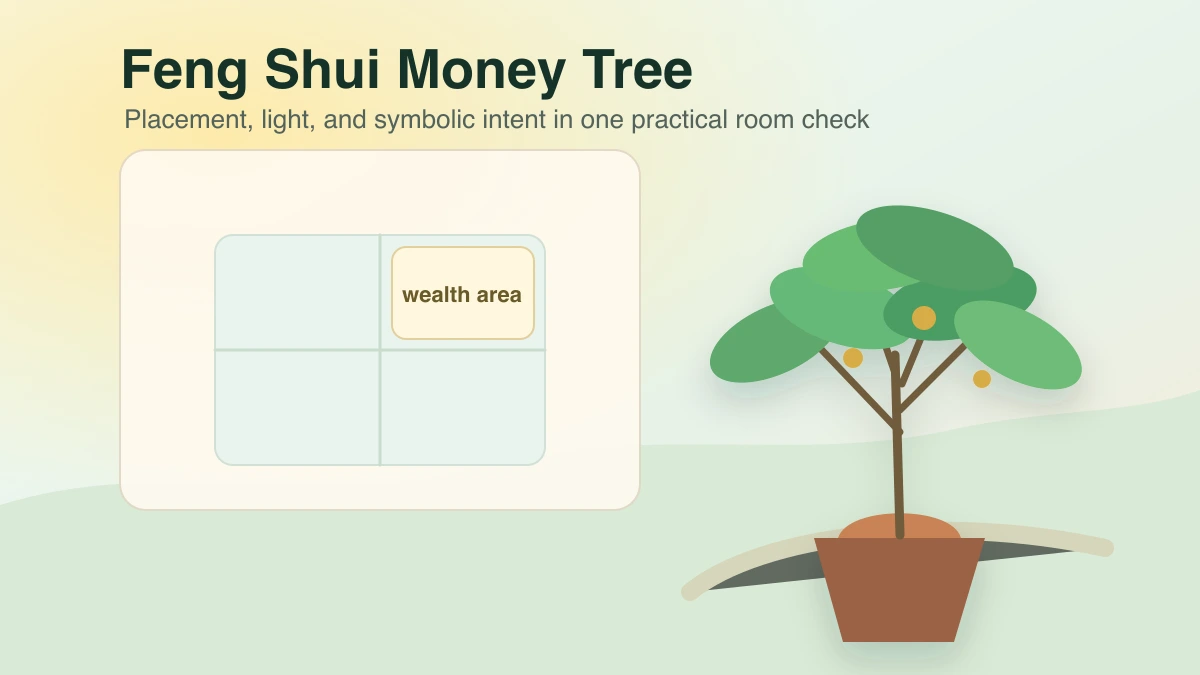
A feng shui money tree works best when it is treated as both a living plant and a symbolic cue. Put it where the room can support healthy growth, then use Feng Shui ideas to decide whether that corner also supports calm, visible, well-kept energy.
If you only remember one rule, make it this: a money tree should not be hidden in a dark, cluttered, or stressful spot just because that corner sounds lucky. In FateFolio's Feng Shui style, symbolism is useful when it supports real space quality, not when it replaces it.
Quick Placement Answer
For most homes, the best feng shui money tree placement is a bright, clean corner connected with growth, welcome, or steady work. Many readers start with the southeast wealth area, but a healthy plant near an entry, desk, living room, or bright side corner can be more useful than a technically correct place with poor light.
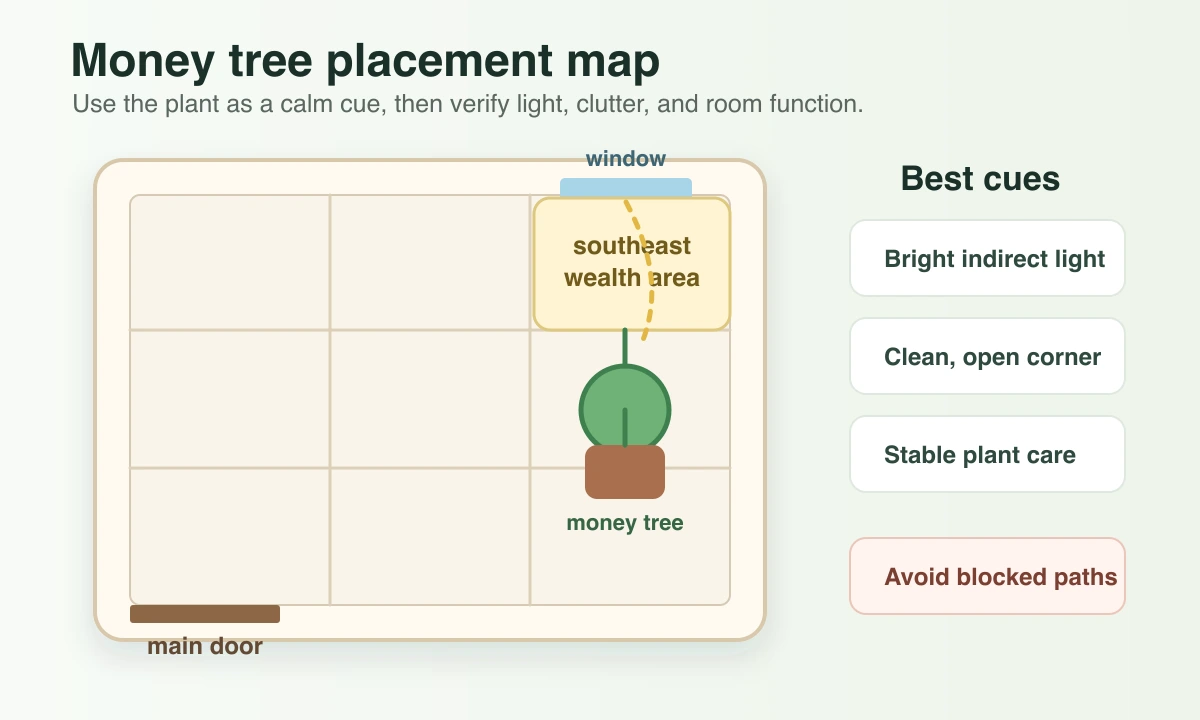
| Placement choice | When it works | What to check first |
|---|---|---|
| Southeast wealth area | The room has light, space, and low clutter | Do not force the plant into a dark corner |
| Entry-side corner | You want a welcoming visual cue near arrival | Keep the path open and leaves protected |
| Desk or work-area side | You want a steady growth symbol near daily effort | Avoid crowding screens, cables, and paperwork |
| Living room corner | You want shared, visible plant energy | Pair with soft light and a stable pot |
The public FateFolio wiki page on the Wealth Position explains why the prosperity corner matters in Feng Shui. This article is narrower: it focuses on the money tree itself, including where the plant can actually thrive.
How to Choose the Right Spot
Start with the plant before the symbol. A money tree usually needs bright indirect light, steady watering, and enough space for leaves to open without being brushed by traffic. If those practical needs fail, the symbolic placement will feel weak because the plant itself looks stressed.
Use this sequence:
- Find two or three bright indirect-light locations.
- Remove any corner that blocks a walking path or door swing.
- Prefer a stable surface or pot where the plant feels anchored.
- Check whether the spot supports the room's function.
- Add Feng Shui symbolism only after the physical fit is sound.
That final step is where the Bagua in Feng Shui becomes useful. The Bagua map can help you compare directions and life areas, but the map is still read together with room use, light, and qi movement.
Best Rooms and Corners
A living room is often the easiest place to use a money tree because the plant is visible, social, and easier to maintain. A home office can also work, especially if the tree sits to the side of the desk rather than directly between you and your tools.
A bedroom can work only when the plant is small, healthy, and not visually busy. If the room already feels crowded, a money tree may add maintenance pressure instead of calm. A kitchen can work if heat, steam, and traffic are not too strong.
The front door area is popular, but it needs care. If the plant narrows the entry path, gets hit by bags, or sits in cold drafts, choose a different spot. Feng Shui reading is about the whole space, not one object.
What to Avoid
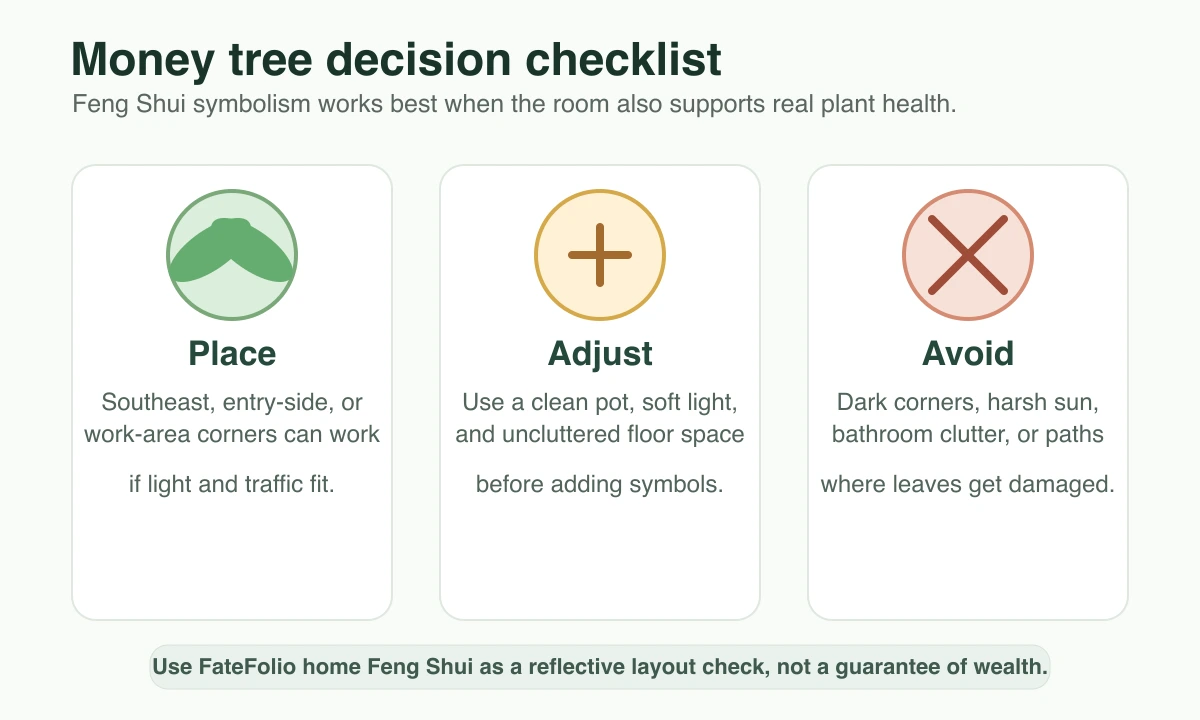
Avoid placing a money tree where it becomes a stressed object. The most common problem is forcing the plant into a wealth corner that has no plant-friendly conditions.
Do not place it:
- In harsh direct sun that scorches leaves.
- In a dark hallway where growth becomes weak.
- In a bathroom corner with heavy dampness or clutter.
- In a narrow path where people brush against it.
- In a dead corner used for storage piles.
Also avoid treating the plant as a fix for every financial concern. In traditional Feng Shui language, a money tree may symbolize growth and prosperity, but practical choices still matter. Keep the tone reflective rather than superstitious: the plant can remind you to care for your space, routines, and decisions.
How FateFolio Fits
Use a money tree placement check as a small room audit. Ask what the plant reveals about light, clutter, visibility, and intention. If you want a broader reading, FateFolio's home Feng Shui map reading is a better next step because it looks at location, surroundings, and spatial patterns rather than one decorative object.
FateFolio Feng Shui
Check your home layout with Feng Shui context
Use FateFolio to review space, direction, qi flow, and layout patterns as reflective guidance.
You can also use the general Feng Shui wiki guide when you want the bigger framework behind qi flow, form, compass ideas, and practical room harmony.
Final Takeaway
A feng shui money tree is strongest when the living plant, the room, and the symbolic intention agree. Choose a place with bright indirect light, open movement, and a clear purpose. Then use wealth-position and Bagua ideas as supporting context, not as rigid rules.

About the editor
FateFolio Editorial
FateFolio Editorial
FateFolio Editorial writes plain-language notes on Bazi, I Ching, Feng Shui, readings, and timing—with the reasoning and limits kept in view.
Related posts
Feng Shui Jade Plant Placement Guide
Learn Feng Shui jade plant placement, what to avoid, how it differs from Money Tree advice, and why real plant care comes first.
Feng Shui Sofa Placement Guide
Learn where to place a sofa in Feng Shui, what to avoid, and how to balance wall support, entry view, traffic flow, and comfort.
Feng Shui Dragon Statue Placement Guide
Learn where a Feng Shui dragon statue fits, what it symbolizes, when to avoid it, and how FateFolio reads the full home context.