Elephants With Trunk Up Meaning and Placement
Learn what elephants with trunk up mean, how trunk-up and trunk-down symbolism differ, and where a figurine can fit without fixed luck promises.
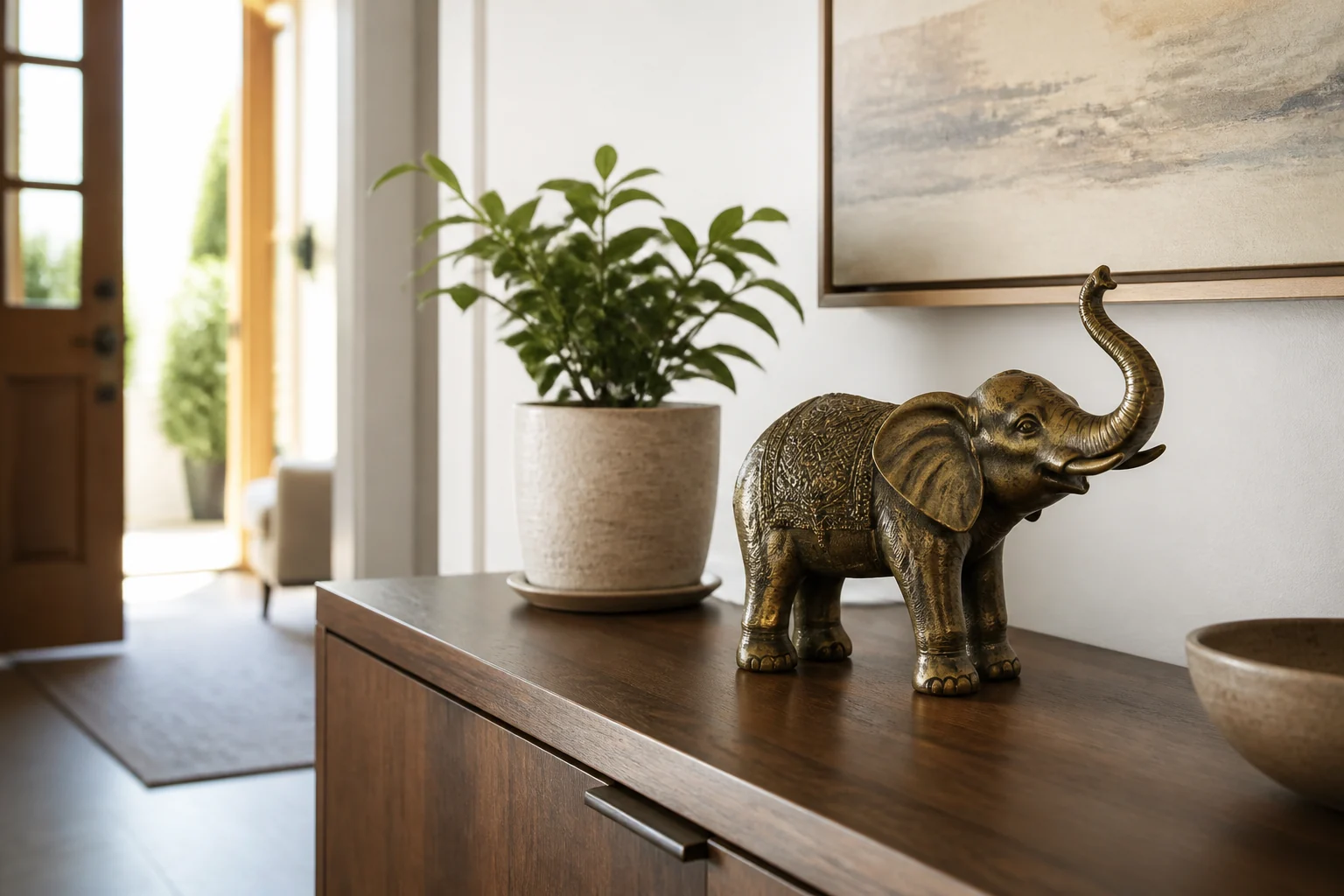
Elephants with trunk up commonly mean welcome, confidence, celebration, protection, or good fortune in modern decor and Feng Shui discussions. The raised trunk creates an upward, active gesture, so people often choose it as a positive symbol near an entry, living room, or work area.
That meaning is not a universal rule. Elephant symbolism travels across different cultures, religious traditions, regional crafts, family customs, and contemporary retail language. A trunk-up figurine can be meaningful without becoming a guarantee of money, health, fertility, safety, or luck.
Quick Meaning Of An Elephant With Trunk Up
A raised trunk is usually read as an expressive, outward-moving posture. In home decor, it can suggest optimism, greeting, strength, or an intention to lift the energy of a room. It is often chosen when the owner wants the object to feel active rather than quiet.
Use this as a starting interpretation:
| Figurine feature | Common modern reading | Practical placement question |
|---|---|---|
| Trunk raised | Welcome, celebration, upward movement, good fortune | Does the object feel open and positive in this room? |
| Trunk lowered | Grounding, gathering, steadiness, inward focus | Would a calmer posture suit the room better? |
| Pair of elephants | Partnership, family, mutual support | Does the pair fit the scale and purpose of the space? |
| Elephant with calf | Care, continuity, protection of family | Is the symbolism personally meaningful rather than fear-driven? |
| Large decorated statue | Strong visual presence and ceremonial weight | Is it overwhelming the furniture or walking path? |
The meaning should come from the whole object and its context, not the trunk alone. Material, scale, facial expression, craftsmanship, family history, and room purpose can change how the figurine feels.
Trunk Up And Trunk Down Are Not Good Versus Bad
The simplest online explanation says trunk up is lucky and trunk down is unlucky. That is too rigid. A lowered trunk can be read as calm, grounded, gathering, or protective. It may suit a quiet room better than an energetic raised gesture.
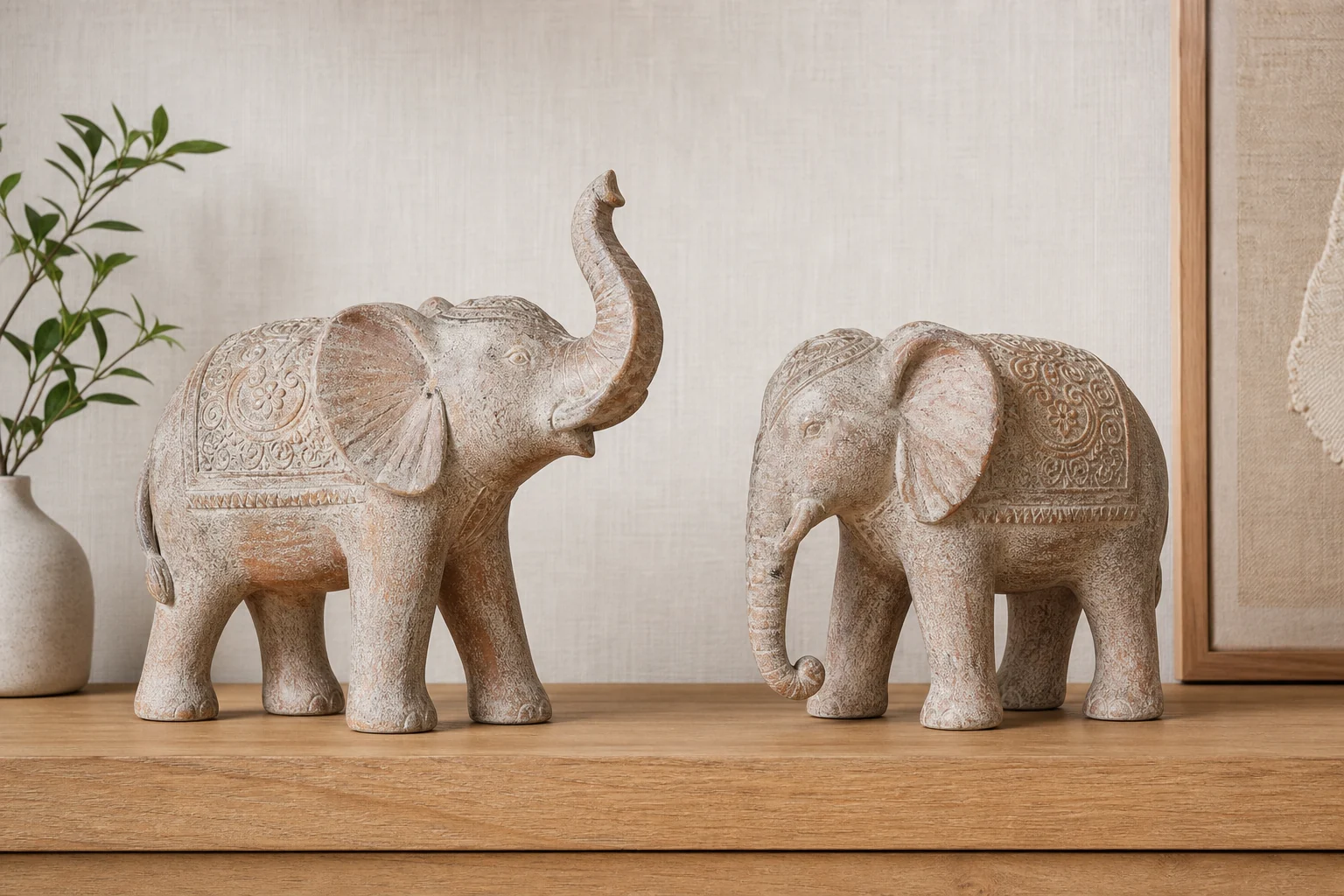
Compare the positions by room job:
| Room or intention | Trunk-up posture may fit when | Trunk-down posture may fit when |
|---|---|---|
| Entry | You want a lively, welcoming accent | You want a quieter, grounded arrival |
| Living room | The room is social and active | The room is calm and reflective |
| Home office | The figurine represents confidence or momentum | The figurine represents patience or concentration |
| Bedroom | Usually only if the piece feels gentle and small | A softer posture may be less visually active |
| Family display | The raised gesture feels celebratory | The lowered gesture feels protective or settled |
Neither posture is automatically superior. Choose the one that makes sense for the space and for the meaning you actually want to remember.
What Elephant Symbolism Can And Cannot Do
Elephants are widely associated with strength, memory, social bonds, protection, dignity, and endurance. Those themes can make a figurine a useful personal reminder. In a Feng Shui context, however, the object should remain secondary to the room's real conditions.
The Feng Shui wiki explains the broader relationship between people, space, direction, form, and use. A small statue cannot repair a blocked doorway, unstable shelf, broken light, difficult furniture layout, or neglected entrance. It can only add a symbolic layer after the physical space is working.
The Qi Energy concept is helpful when evaluating a display. Ask whether the figurine supports attention and movement or becomes another crowded object. If it narrows the path, disappears behind clutter, or creates anxiety about moving it, the placement is not serving the room.
Use an elephant figurine for:
- a personal reminder of steadiness, welcome, or courage;
- a meaningful craft or family object;
- a restrained focal point in a functional room;
- a conversation piece that connects to a real cultural or personal story;
- a symbolic accent after practical Feng Shui checks are complete.
Do not use it to promise income, conception, medical recovery, relationship certainty, legal success, or protection from every risk.
Where To Place A Trunk-Up Elephant
Start with a stable surface, comfortable scale, and an open path. A trunk-up elephant can work on an entry-side console, living-room shelf, or office bookcase when it feels intentional and does not dominate the room.
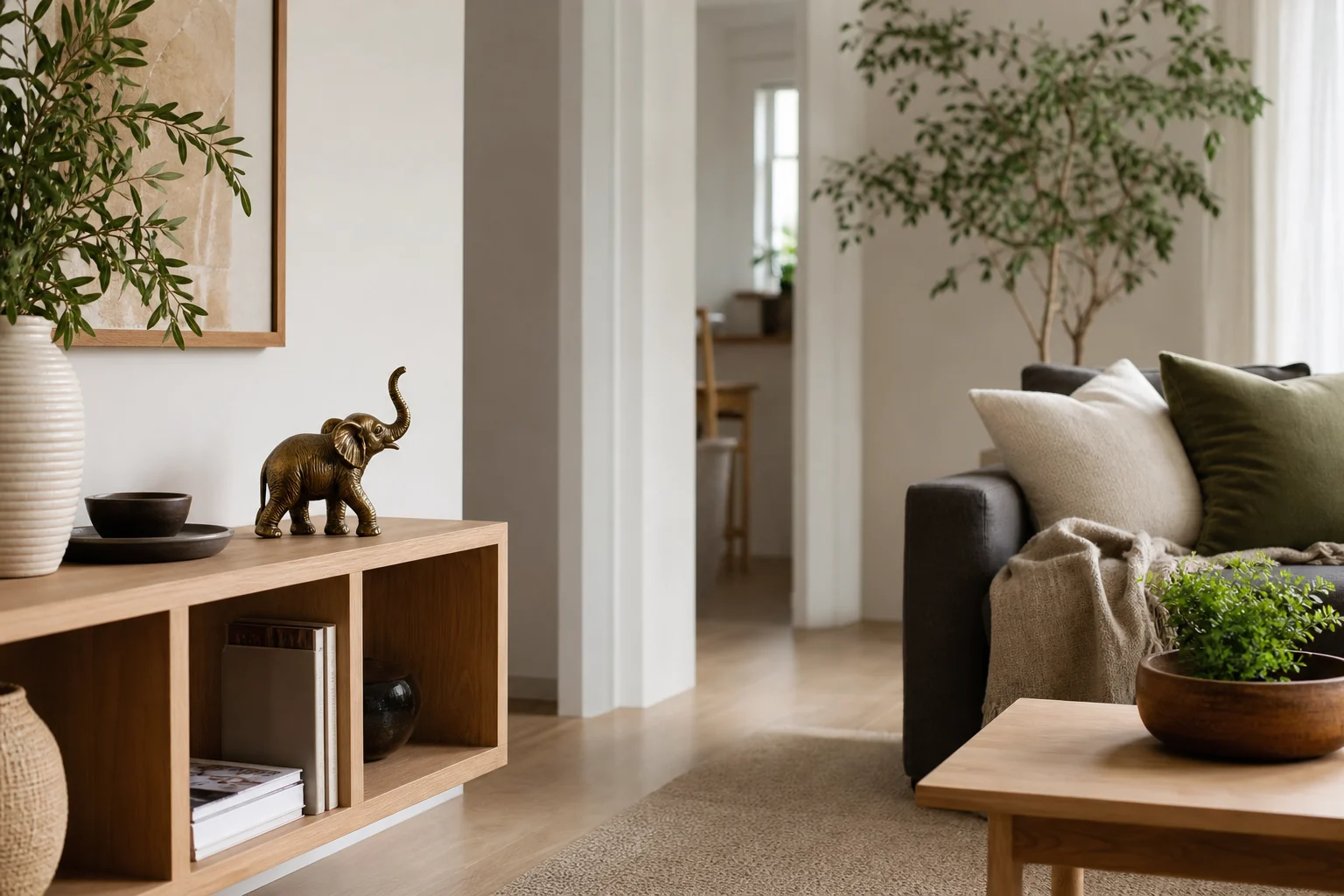
| Placement | Why it can work | What to avoid |
|---|---|---|
| Entry-side console | Creates a visible welcome without standing in the path | Door swing, shoe clutter, unstable edges, oversized statue |
| Living-room shelf | Gives a social room one clear symbolic focal point | Crowding it among many luck objects |
| Office bookcase | Can represent confidence, patience, or steady effort | Placing it where it blocks screens, files, or light |
| Family display | Connects the object with memory or shared meaning | Treating it as a fear-based requirement |
| Protected side table | Keeps a small piece visible and cared for | Pet, child, or traffic risk around a fragile object |
If the figurine sits near the entrance, read the Main Door page before chasing a precise lucky direction. The door's condition, lighting, clearance, and daily use matter more than whether the trunk points toward or away from one compass sector.
There is no universal requirement that the elephant face the door. In one room, facing inward may feel welcoming; in another, facing outward may make the object look disconnected. Step into the space from the normal path and judge the actual composition.
Should An Elephant Go In The Wealth Corner
Some people place a trunk-up elephant in a prosperity or wealth area. That can be a personal ritual, but it should not be framed as a financial mechanism. The Wealth Position wiki explains why wealth corners appear in Feng Shui practice and why the surrounding room still matters.
Before using that location, ask:
- Is the surface stable and easy to clean?
- Does the object fit the scale of the corner?
- Is the area bright enough to feel cared for?
- Does the display leave drawers, doors, and walking paths usable?
- Would the figurine still be meaningful without a promise of quick money?
If the answer to the last question is no, reconsider the placement. Symbolic decor is healthiest when it supports a value or intention you can act on, such as patience, stewardship, courage, or consistent effort.
When To Move Or Avoid The Figurine
Move the elephant when it is physically unsafe, visually overwhelming, emotionally pressuring, or disconnected from the room. Adjusting decor is not disrespectful; it is part of keeping a living home responsive.
Common warning signs include:
- the figurine sits on the floor in a high-traffic route;
- the trunk or tusks point into a seat at close range and feel visually sharp;
- the object is too large for the shelf or console;
- the entry becomes crowded with multiple symbolic cures;
- the piece is broken, unstable, or difficult to clean;
- the owner feels afraid that moving it will cause bad luck;
- the room needs repairs, storage, light, or circulation changes more urgently.
The same practical boundary appears in the published Feng Shui Dragon Statue Placement Guide. A symbolic object can enrich a room, but it should not replace layout, maintenance, comfort, or safety.
Where FateFolio Fits
FateFolio's Feng Shui reading accepts a room image, scene type, orientation, goals, and additional context. It can help when the question depends on the actual entry, shelf, furniture, light, traffic path, or nearby objects rather than a generic trunk-position rule.
Use the result as reflection and layout guidance. If the figurine is valuable, fragile, inherited, religiously significant, or connected to a tradition you do not know well, consult the relevant owner, community, conservator, or cultural source before changing it.
FateFolio Feng Shui
Review the figurine in the room around it
Upload a room image and describe the placement goal so FateFolio can consider the elephant together with entry flow, furniture, light, and scale.
Practical Takeaway And FAQ
Elephants with trunk up commonly symbolize welcome, confidence, strength, celebration, or good fortune. That interpretation is a flexible modern convention, not a universal law. Place the figurine where it is stable, proportionate, visible, and personally meaningful, then let the room's function decide whether the gesture feels right.
Is an elephant with its trunk up good luck?
It is commonly used as a good-luck or uplifting symbol, but it does not guarantee an outcome. Treat it as meaningful decor and a reflection prompt rather than a cure.
Which way should a trunk-up elephant face?
There is no single direction that works for every home. Check the door path, room purpose, furniture, visibility, and how the object reads from the normal entrance before choosing inward or outward orientation.
Is trunk down bad Feng Shui?
No. A lowered trunk can suggest steadiness, gathering, calm, or protection. The room and the owner's intention matter more than a simple good-versus-bad rule.
Can I place an elephant in the bedroom?
You can if the piece is small, gentle, and does not make the room feel active or crowded. Bedrooms often benefit from quieter visual signals, so move it if it feels too strong.
Does an elephant statue attract wealth?
Some traditions and modern decor practices connect elephants with prosperity, but a statue cannot guarantee financial results. Use it as a reminder of patience, stewardship, and consistent effort.

About the editor
FateFolio Editorial
FateFolio Editorial
FateFolio Editorial writes plain-language notes on Bazi, I Ching, Feng Shui, readings, and timing—with the reasoning and limits kept in view.
Related posts
Feng Shui Money Tree Placement Guide
Learn where to place a feng shui money tree, what to avoid, and how to connect wealth symbolism with real room conditions.
Feng Shui Dragon Statue Placement Guide
Learn where a Feng Shui dragon statue fits, what it symbolizes, when to avoid it, and how FateFolio reads the full home context.
Feng Shui Sofa Placement Guide
Learn where to place a sofa in Feng Shui, what to avoid, and how to balance wall support, entry view, traffic flow, and comfort.