

Which romance position are you looking for?
First identify what the calculation takes as its input. A Bazi Peach Blossom marker relates one Earthly Branch to another branch in a chart. A room direction needs an additional spatial convention and a measured orientation. Finding a chart marker does not, by itself, locate a shelf, bed or corner.
- Personal branch method: choose a reference branch, look up the associated branch, then translate it to a compass direction. This page demonstrates that sequence.
- Southwest relationship area: a separate Bagua convention associates relationships with a fixed southwest area. An entrance-aligned Bagua uses a different reference again; do not rotate a compass result to fit it.
- Annual Flying Stars: a time-based system changes its assignments with the year and method. A fixed personal branch lookup does not calculate this annual chart.
This article concerns the step from symbolic branch to physical room. For identifying a Peach Blossom marker inside the Four Pillars, use the related Peach Blossom entry. Neither entry treats a marker as evidence of attractiveness, infidelity or future marriage.
The branch lookup and its historical boundary
The Xian Chi section of San Ming Tong Hui records four group correspondences. Each reference branch belongs to one group; you do not need all three group members in a chart to use this simplified lookup.
- Yin–Wu–Xu (寅午戌; Tiger, Horse, Dog) → Mao (卯) → east.
- Si–You–Chou (巳酉丑; Snake, Rooster, Ox) → Wu (午) → south.
- Shen–Zi–Chen (申子辰; Monkey, Rat, Dragon) → You (酉) → west.
- Hai–Mao–Wei (亥卯未; Pig, Rabbit, Goat) → Zi (子) → north.
State whether your reference is the birth-year branch or birth-day branch. These are different inputs and may yield different directions. The example below deliberately uses the year branch, following the zodiac-based room convention documented by contemporary practitioner Lau Tin Hang. It does not silently substitute the day branch or calculate either branch from a calendar date.
Worked example: a Wu year branch and an east wall
Assume a hypothetical resident has an already confirmed birth-year branch of Wu (午, Horse). We choose the year-branch convention for this exercise. Their rectangular living room has a door on the west wall, a sofa along the south wall and an existing low cabinet on the east wall. No birth date, personality or relationship outcome is inferred.
- Record the input: year branch Wu (午). Wu belongs to Yin–Wu–Xu (寅午戌), whose lookup result is Mao (卯). The directional correspondence for Mao is east.
- Choose the living room as the measurement frame and mark its approximate center on a simple floor plan. This is a room-scale illustration, not a claim about the whole dwelling or a formal house chart.
- Calibrate a compass or compass app, move away from large metal objects and take repeated readings. Keep one north reference throughout: if your device uses true north, label the plan true north; if it uses magnetic north, label that instead. Do not mix readings.
- From the center, identify north at 0°, east at 90°, south at 180° and west at 270°. Rotate the plan to match the measured room. On the north-up example, east is the right-hand wall; an entrance or a photo does not establish north.
- Trace the 90° east ray from the center to the east wall. In this assumed room it reaches the low cabinet. Clear its clutter; if the corner needs light, use a stable small lamp with a safely routed cable. Keep the west-door route and access to the sofa clear.
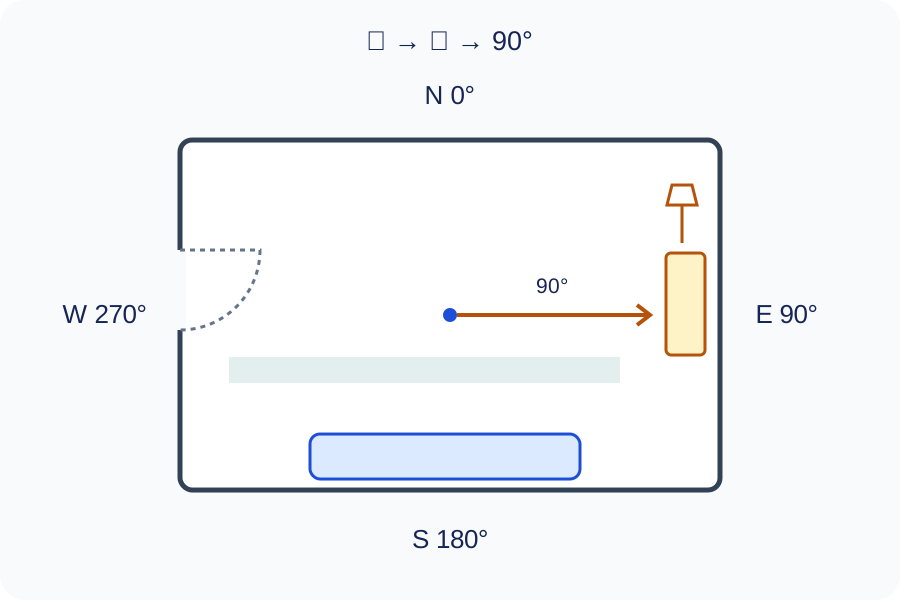
The result is a reproducible symbolic direction and a tidier, usable cabinet area. We have not established a 15° or 45° sector width, a Flying Star chart, a whole-house center or a need to move the bed. Those would require separate conventions and inputs. A room rotated relative to north would place the east ray elsewhere on its drawing.
What placement can and cannot tell you
Treat this as a way to understand a cultural spatial convention. Neither a branch correspondence nor a practitioner’s placement advice establishes that arranging objects attracts a partner or repairs a relationship. There is no demonstrated waiting period in the sources used here.
- If the ray meets a doorway, bathroom or shared area, record that result. Do not obstruct access or invent a new direction to obtain a nicer corner.
- If compass readings disagree, leave the direction unresolved and repeat the measurement. A photo without a north reference cannot supply the missing orientation.
- Flowers, pairs, water features and crystals are optional decorative or ritual choices in some accounts. This example requires none of them and does not claim an activation effect.
- A single branch does not reveal consent, relationship status, fidelity or another person’s intentions. Judge those through communication and observed behavior.
For a shared home, choose changes together and assess tangible results: does the cabinet stay usable, is the lamp comfortable, and can everyone move through the room? These observations evaluate the layout itself.
Using FateFolio for the room review
FateFolio’s image-based Feng Shui analysis accepts a space image, scene type, selected goals, optional orientation and additional notes. Its standard input does not collect birth-year or birth-day data, and we have not verified a dedicated personal Peach Blossom direction calculator. Selecting a love-related goal is not the same as computing this lookup.
For this example, supply a clear room image and describe the measured orientation, west entry, south sofa and east cabinet. Use the report to review visible layout suggestions. Check each suggestion against the actual floor plan and access needs; keep the branch lookup and compass measurement as explicit inputs you have already established.
Sources: chart rule, direction and later room convention
San Ming Tong Hui, Siku edition, volume two: locate “論咸池” for the four group correspondences and the Na Yin qualification, and “十二支分配地理” for Zi north, Wu south, Mao east and You west. The linked full-text edition makes both passages available. The historical moral judgments around Xian Chi are not adopted here.
Lau Tin Hang’s article collection, passage headed “自己動手催旺桃花”, documents a contemporary zodiac-to-room-direction convention. It establishes that this convention is used by that author; it does not verify the article’s promised effects. Our compass procedure and cabinet arrangement are clearly labeled explanatory choices, not quotations from either source.
The International Feng Shui Guild glossary separates an entrance-aligned BTB Bagua, the southwest Earth/relationship association and annual stars. It supports the comparison of conventions here, rather than the personal lookup or an effectiveness claim.
Quoted excerpts
卯係乙木居位正東
Mao is associated with Yi wood and occupies due east.
References
- 《三命通會》四庫本卷二:論咸池、十二支分配地理 · Wikisource
- 劉天恆:自己動手催旺桃花(現代生肖方位取法)
- International Feng Shui Guild glossary: Earth, BTB Feng Shui and Annual Star · International Feng Shui Guild