

What the marker identifies
In the modern convention used here, choose the year branch or day branch, find its group below, then search the natal chart for the target branch. The reference selects the row; the target is the character you look for. Neither the Heavenly Stem nor the animal name alone tells you the location of a match.
A branch can appear in the year, month, day or hour pillar. Record the pillar name alongside any match so another reader can reproduce your result. This page concerns a natal chart marker; a Peach Blossom position in a room is a different application and requires its own spatial method.
Four-group lookup: reference → target
The following four rows follow the contemporary FATEREAD teaching page’s stated year-or-day method. Any one branch in a row selects that row; all three do not need to be present, and this lookup does not prove a three-harmony combination has formed.
- 申、子、辰 → 酉
- 寅、午、戌 → 卯
- 巳、酉、丑 → 午
- 亥、卯、未 → 子
For example, a Shen (申) reference selects You (酉), even if Zi and Chen are absent. Select one reference at a time. If comparing year and day methods, retain two labeled results instead of silently combining them into a stronger claim.
One chart, two declared references
Teaching example only: the supplied hypothetical natal branches are YEAR 申, MONTH 酉, DAY 午, HOUR 子. No Gregorian birth date, Heavenly Stems or complete calculated birth chart is supplied. We can demonstrate the branch lookup, but cannot reconstruct Na Yin or a full Bazi interpretation from these four characters.
- Year reference: 申 belongs to 申、子、辰 → 酉. Scan the four natal positions: year 申 is not 酉; month 酉 matches; day 午 and hour 子 do not. Record: year-based target 酉, found in the month pillar.
- Day reference: 午 belongs to 寅、午、戌 → 卯. None of 申、酉、午、子 is 卯. Record: day-based target 卯, no natal match in the four supplied branches.
- Compare the records: the chart has not changed. Changing the declared reference changes the target and therefore the lookup result. “Year-based month match; day-based no match” is more informative than a single yes/no label.
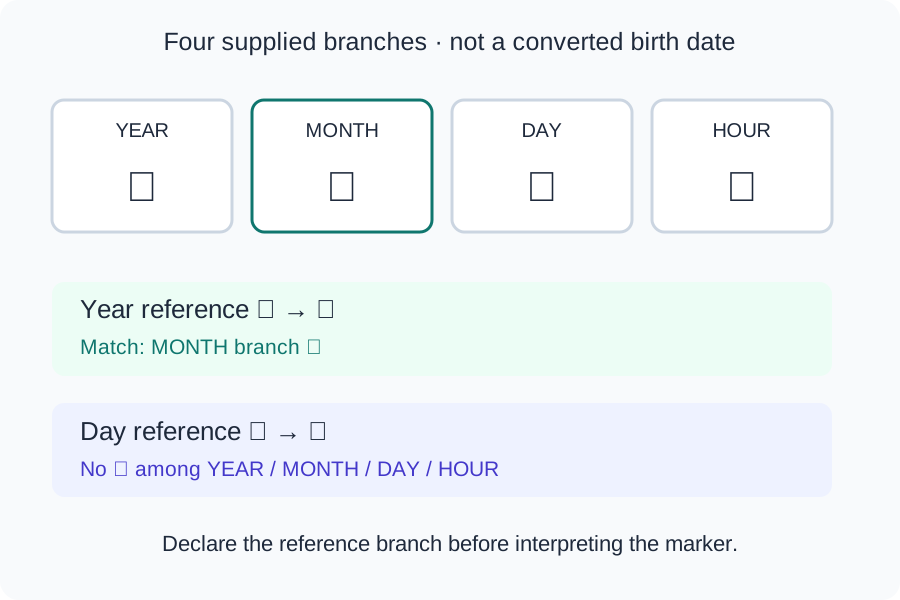
A useful countercheck is the hour 子: although it is one of the four possible Peach Blossom target characters, it is not the target of either reference in this example. Counting every 子、午、卯、酉 as Peach Blossom would incorrectly count three positions. The lookup is a relationship between a reference and a target, not a count of those four characters.
Natal matches and incoming branches
Natal means the branches already supplied in the birth chart. An incoming year, month or luck-period branch is a separate time layer. If an incoming period is 卯, it matches the day-reference target in this example for that period; it does not put 卯 into the original four pillars or change the natal “no match” record.
Keep a separate note with the incoming period and branch, the natal reference used, and the target compared. We supply no dated transit calculation here. A symbolic temporal match is not evidence that someone will meet a partner, marry or be unfaithful.
What the result cannot establish
The historical Xian Chi section in San Ming Tong Hui includes a Na Yin qualification: the Heavenly Stem’s natal-sound category must agree with the relevant category. Our branch-only example cannot test that condition. The four modern lookup rows should therefore not be presented as the complete, identical rule of that edition.
The text also contains harsh gendered and moral judgments. Neither that language nor a modern lookup establishes attractiveness, fidelity, sexual behavior or relationship quality. A missing marker does not mean a person cannot be loved, and a repeated target is not a relationship score.
When two reports disagree, first compare their reference branches, supplied pillars and whether they include incoming periods. A missing birth hour leaves the hour position unchecked; report “not found in the known pillars” rather than inventing an hour or claiming a complete absence.
Use the Bazi tool to obtain the pillars
FateFolio’s structured Bazi calculation produces year, month, day and, when a birth time is supplied, hour pillars. It also computes elemental counts, Ten Gods and branch clash/combination signals. It does not compute a dedicated Peach Blossom marker or provide a year-versus-day reference selector.
Use the tool to obtain the pillars, copy the branch from each known position, then apply the declared lookup above yourself. A general relationship passage in a report is not proof that this particular marker was calculated. If birth-time information is missing, leave the hour blank and preserve that limit in your notes.
Sources and the scope of each
San Ming Tong Hui, Siku edition, volume two, “論咸池”, is linked through its full-view transcription. It supports the historical name, group correspondences and Na Yin caveat. The short quotation below preserves its terminology without adopting its judgments.
The modern FATEREAD “桃花” lesson explicitly states a year-or-day reference and gives the four lookup rows. We use that procedural portion only, not its claims about personality or fidelity. The supplied four-branch example, countercheck and separate natal/transit record are editorial demonstrations of the declared method, not a sourced person’s life story.
Quoted excerpts
一名敗神一名桃花煞
Also called Bai Shen; also called the Peach Blossom sha.
References
- 《三命通會》四庫本卷二:論咸池(全覽) · Wikisource
- 知命 FATEREAD:桃花 — 查法 · 知命 FATEREAD