

What makes Plum Blossom different?
Plum Blossom, or Meihua Yishu, is a Yijing divination tradition that works with numbers and images: a count, a time or an observed object can supply the trigrams. Its received manual is conventionally attributed to Shao Yong. That attribution and the stories told about him do not establish who composed every passage of the surviving text.
The Yijing provides the shared vocabulary of yin and yang lines, eight trigrams, sixty-four hexagrams and their texts. Plum Blossom adds particular ways of selecting a hexagram and comparing trigram images and five-phase relationships. It is therefore a method within that wider tradition, rather than a synonym for the whole I Ching.
Liu Yao, the Six Lines method, commonly builds an interpretation around line-level assignments such as Na Jia, six relatives, the subject and responding lines, and calendrical relationships. A Plum Blossom reading instead often begins with upper and lower trigram images and body–use relationships. The same hexagram can appear in either method; switching interpretive systems midway changes the reading rather than merely adding detail.
Choose the input rule before doing the arithmetic
For the two-number convention used here, choose positive whole numbers A and B. A supplies the upper trigram; B supplies the lower trigram; A + B supplies one moving line. Do not silently add the clock time, reverse the numbers or reduce them to digit sums halfway through. Those are different casting conventions.
- Divide A by 8 and keep the remainder for the upper trigram. A remainder of 0 means trigram 8, Kun.
- Divide B by 8 in the same way for the lower trigram. A remainder of 0 again means Kun.
- Divide the original total A + B by 6. A remainder of 0 means line 6; the other remainders identify lines 1–5.
- Place the lower trigram at the bottom and the upper trigram above it. Number all six lines upward from the bottom: 1, 2, 3, 4, 5, 6.
- Reverse only the designated moving line: yang becomes yin, or yin becomes yang. Read the resulting trigrams as the changed hexagram.
Volume One also gives distinct rules for time and object counts. In its year–month–day–hour example, the year branch is numbered Zi = 1 through Hai = 12; the month and day are lunar calendar numbers. The year + month + day total supplies the upper trigram; adding the hour branch supplies both the lower trigram total and the moving-line total. Its object-count rule pairs the count with an hour number. Our two-number exercise is not a claim that every classical method omits time.
The eight trigram numbers and line patterns
The sequence below follows Volume One, 周易卦數. Every three-line pattern here is listed from bottom to top. A solid line is yang; a broken line is yin. These casting numbers are not the separate Luo Shu nine-palace numbers.
- 1 — Qian 乾, Heaven: yang–yang–yang; Metal.
- 2 — Dui 兌, Lake: yang–yang–yin; Metal.
- 3 — Li 離, Fire: yang–yin–yang; Fire.
- 4 — Zhen 震, Thunder: yang–yin–yin; Wood.
- 5 — Xun 巽, Wind: yin–yang–yang; Wood.
- 6 — Kan 坎, Water: yin–yang–yin; Water.
- 7 — Gen 艮, Mountain: yin–yin–yang; Earth.
- 8 — Kun 坤, Earth: yin–yin–yin; Earth.
Upper and lower describe placement, not which trigram matters more. The lower trigram contains lines 1–3 and the upper contains lines 4–6. If you draw the diagram with line 6 at the top, your written bottom-up list will appear reversed on the page; that is a display change, not a different cast.
A complete 3/5 example: Ding changing to Lu
Suppose the learning question is: “What should I prepare before joining a new project?” We deliberately choose 3 and 5 to make the calculation easy to check. This is an editorial exercise, not a historical consultation or a reported outcome.
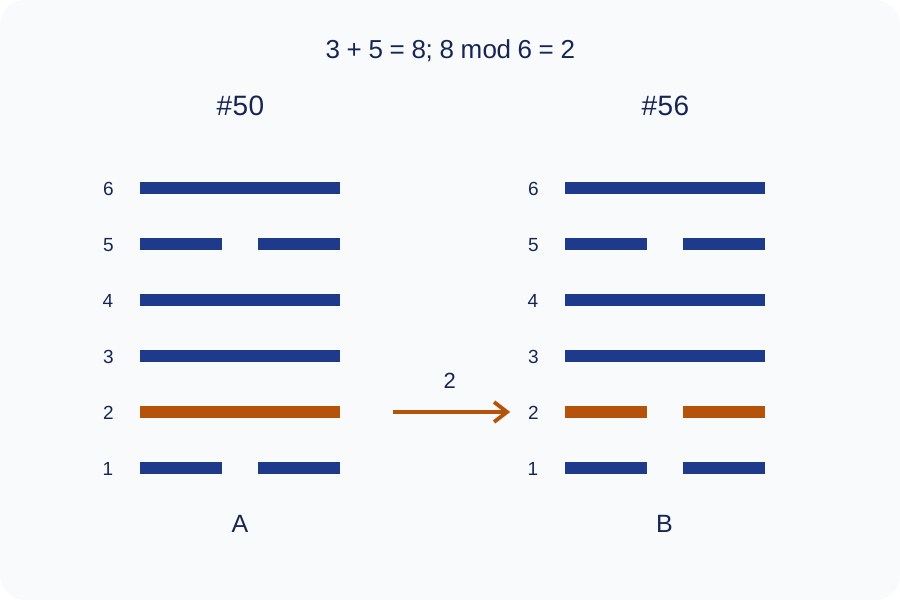
- Set A = 3 and B = 5. Their remainders on division by 8 are 3 and 5: Li is upper, Xun is lower.
- Stack Xun below Li. From line 1 upward the primary hexagram is yin–yang–yang–yang–yin–yang. Fire over Wind is Ding 鼎, hexagram 50.
- Add the original numbers: 3 + 5 = 8. Since 8 = 6 × 1 + 2, line 2 moves. It is the middle line of the lower trigram, not the second line from the top.
- Line 2 is yang. Change it to yin and leave the other five lines alone. The changed pattern is yin–yin–yang–yang–yin–yang.
- The lower pattern is now Gen, Mountain, while upper Li is unchanged. Fire over Mountain is Lu 旅, hexagram 56. The Zhouyi entries identify Ding as Xun below Li and Lu as Gen below Li.
Next calculate the inner, or mutual, trigrams from the primary pattern, before changing it. Lines 2–3–4 are yang–yang–yang: lower inner Qian. Lines 3–4–5 are yang–yang–yin: upper inner Dui. Together they form Lake over Heaven, Guai 夬. That inner structure is not Lu; Lu came from changing line 2.
For body–use roles, the moving line lies in lower Xun, so lower Xun is use and unchanged upper Li is body. Xun belongs to Wood and Li to Fire: in the traditional five-phase cycle, use generates body. After the change, lower Gen belongs to Earth, which body Fire generates. These are different relationships at different stages, not grounds for declaring the project a success or failure.
A boundary case: 8 and 4
- 8 divides exactly by 8, so the upper trigram is Kun, number 8. The second input 4 gives lower Zhen.
- Earth over Thunder is Fu 復. Its six lines, bottom upward, are yang–yin–yin–yin–yin–yin.
- The original sum is 8 + 4 = 12. Division by 6 leaves 0, so line 6 moves. There is no line 0.
- Change the top yin line to yang. Upper Kun becomes Gen, lower Zhen remains unchanged: Mountain over Thunder, Yi 頤. The changed bottom-up pattern is yang–yin–yin–yin–yin–yang.
This example catches both exact-division mistakes. Because the moving line is in the upper trigram, upper Kun is use and lower Zhen is body—the opposite placement from the 3/5 example. Body is therefore not permanently the upper trigram.
Primary, changed, inner, body and use are different roles
- Primary hexagram: the original six-line arrangement produced by the cast.
- Moving line: the single selected line in this number convention; its position determines which trigram changes.
- Changed hexagram: the six-line arrangement after that line reverses yin/yang.
- Inner or mutual hexagram: an overlapping extraction from the primary lines—2–3–4 below and 3–4–5 above. Nothing is flipped to obtain it.
- Body and use: interpretive labels for the two original trigrams. In this single-moving-line convention, the trigram containing the moving line is use, and the other is body.
Volume Two treats body as the subject and use as the matter encountered; it relates the inner structure to the intervening process and the changed structure to the concluding stage. These are traditional reading roles, not measurements of when real events will occur. Its five-phase framework reads use generating body as support, body generating use as expenditure, use overcoming body as pressure, body overcoming use as control, and matching phases as affinity. Seasonal strength and context complicate these labels.
Turn an interpretation into questions you can check
For the hypothetical project question, Ding’s vessel and cooking image can prompt questions about what is already prepared and who will contribute. Lu’s traveler image can prompt questions about joining an unfamiliar setting, working agreements and temporary responsibilities. These are our reflective applications of the images, not translations of a promise that a new job or journey will occur.
- Keep the calculation in one column: inputs, stated convention, primary hexagram, moving line, changed hexagram and inner trigrams. Another reader should be able to reproduce it.
- Keep the interpretation in another: which image or body–use relationship led to each question? Compare the moving second line of Ding with the original text rather than borrowing a different line to fit the situation.
- Write an observable next step: clarify the project scope, check available resources and ask who owns the first deliverable. Record what actually happens separately from what you expected.
A repeatable remainder calculation proves that the symbols follow the stated rule. It does not prove that the symbols forecast external events. The traditional anecdotes, including the plum-tree story, are evidence of what the manual narrates; they do not supply independently verified outcomes or a predictive accuracy rate. Repeatedly recasting until a pleasing answer appears also makes the record harder to evaluate.
Reproduce the number convention in FateFolio
In the I Ching tool, select Plum Blossom and enter 3, 5 in the number field. With two inputs, the implementation uses the first for the upper trigram, the second for the lower and their sum for the moving line. It does not automatically add the current hour to this method. Enter both numbers to reproduce the exercise; omitted inputs can be generated randomly.
An optional third number supplies the moving-line total directly. Thus 3, 5, 6 keeps upper Li and lower Xun but selects line 6 instead of line 2. A three-number input is a different declared convention, not a second verification of the two-number example. Use positive whole numbers for this exercise.
The tool calculates trigram indices and the moving-line index before requesting an AI interpretation. The report is asked to identify the primary and changed hexagrams from those data; you can cross-check its names against the patterns above. This page explains inner trigrams and body–use analysis for study, but does not promise dedicated inner-hexagram or body–use fields in every generated report.
Which sources support which parts?
- Meihua Yishu, Volume One: 周易卦數 and 八卦象例 supply the number sequence and trigram patterns; 卦以八除 and 爻以六除 supply the remainder and line-change rules; 互卦起例 and 年月日時起例 document inner extraction and time casting.
- Volume Two: 體用總訣 explains the subject/matter roles and five-phase comparisons. 占卜論理訣 insists on reasoning about context rather than treating one image as a fixed literal answer.
- Volume Three: 變卦式八則 explicitly distinguishes the moving use from the still body; 體用互變之訣 discusses use, inner and changed stages.
- Zhouyi, Ding and Lu: the named entries establish Xun below Li and Gen below Li, with their respective line texts and images. The 3/5 and 8/4 inputs are our teaching cases.
- Zhouyi, Guai, Fu and Yi: these entries cross-check the inner hexagram and the zero-remainder case. Zengshan Buyi, Volume One, documents line assignments, six relatives, subject/responding lines and calendar chapters used in the Liu Yao comparison.
- The Meihua Yishu preface and appendix show its Shao Yong tradition. They are not an authenticated manuscript chain establishing personal authorship or independent scientific evidence for its anecdotes.
The linked Wikisource pages are accessible transcriptions of received classical texts, not a critical edition collating all manuscript variants. The worked arithmetic and modern reflection prompts are editorial explanations; the two-number product convention is checked against FateFolio’s implementation rather than presented as the only classical rule.
Quoted excerpts
卦以八除
Reduce trigram numbers by division by eight.
動者為用,靜者為體。
The moving part is use; the still part is body.
References
- 《梅花易數》卷一:周易卦數、卦以八除、爻以六除、互卦起例 · Wikisource
- 《梅花易數》卷二:體用總訣、占卜論理訣 · Wikisource
- 《梅花易數》卷三:變卦式八則、體用互變之訣 · Wikisource
- 《梅花易數》序、附錄:傳承敘事與邵雍歸屬 · Wikisource
- 《周易》第五十卦:鼎,巽下離上 · Wikisource
- 《周易》第五十六卦:旅,艮下離上 · Wikisource
- 《周易》第四十三卦:夬,乾下兌上 · Wikisource
- 《周易》第二十四卦:復,震下坤上 · Wikisource
- 《周易》第二十七卦:頤,震下艮上 · Wikisource
- 《增刪卜易》卷之一:渾天甲子、六親歌、世應、月將、日辰 · Wikisource