

Where is the Life Palace?
Start with the inner ends of the eyebrows and the top of the nose. The small central region between them is the facial Life Palace. It is not the whole forehead, either eyebrow, or the bridge of the nose. Yin Tang is a traditional regional name; it is not a clinical measurement.
Allanson and colleagues describe the anatomical glabella as the midline forehead area between the brow ridges, just above the nasal root. This gives a useful anatomical reference for the location, without making the historical palace a medical category.
- Forehead: the broader area above the brows; forehead height is not Life Palace width.
- Eyebrows: the hair-bearing structures on either side; grooming and brow movement can alter the apparent gap.
- Zi Wei Dou Shu Life Palace: a position in a birth chart. Its stars and chart placement are not located by examining a face. The shared name does not make the two systems interchangeable.
What the historical source actually says
The Twelve Palaces passage reproduced in Gujin Tushu Jicheng, Arts section, juan 631, opens its Life Palace entry with a location:
This means “The Life Palace lies between the two eyebrows, above the root of the nose.” The linked scan is image page 12 of the volume 473 file, not juan 473. Its transcription is marked unproofread; this short location phrase was checked against the scan.
The surrounding historical passage associates brightness, lines and facial form with learning, wealth and misfortune. Those are beliefs recorded in a physiognomy tradition, not established relationships. Its descriptive vocabulary can explain old texts; it cannot justify judging a living person by skin tone, brow spacing or scars.
A repeatable way to observe the region
For a useful comparison, keep the image conditions consistent and write down what remains uncertain. The aim is to locate a region and describe visibility, not to score a face.
- Use your own photo, or a photo the person has explicitly allowed you to use. Keep the full brow area and nasal root in frame; remove obstructions only if comfortable.
- Face the camera with the head level and brows relaxed. Keep the same camera, distance, angle and crop for comparison; avoid a close wide-angle selfie.
- Use soft, even illumination. Keep exposure consistent where possible; avoid beauty filters, smoothing and strong side shadows. Record any makeup or editing that changes what is visible.
- Describe only what the image supports: where the brow gap lies, whether a crease is visible, and whether a shadow obscures an edge. Use “unclear in this photo” when appropriate.
- If comparing expression, change brow position while holding lighting and framing constant. If comparing light, keep the expression fixed. Repeat once under the baseline conditions before drawing conclusions about appearance.
Do not use a two-finger rule as a universal ideal. A finger is not a standardized scale, eyebrow hair is not a bony landmark, and an uncalibrated photograph cannot give a dependable anatomical width.
Worked example: one person, two photo conditions
Imagine two photographs of the same fictional person. View A is frontal, with relaxed brows and even illumination. View B is also frontal, but the person furrows their brows and a side light casts a shadow. The drawing below is a schematic teaching example, not a real photo consultation or a measured face.
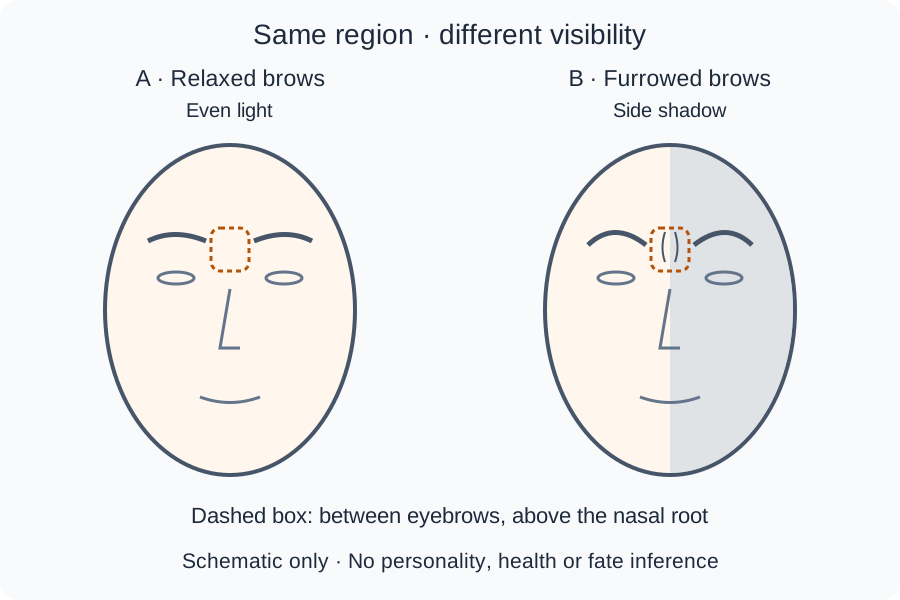
- Locate: the reference region stays between the eyebrows above the nasal root in both views.
- Observe: creases at the brow junction and darker shading are more apparent in B. Record those visible differences without assigning a character trait.
- Limit: expression and light changed together, so this pair cannot isolate their individual effects or prove a lasting change in the skin.
- Repeat: retake B with relaxed brows and the same even light as A. If a mark remains unclear, leave it unresolved rather than giving it a traditional verdict.
Nothing in this pair establishes intelligence, personality, mental state, health, wealth or fate. “B looks darker in this drawing” is an observation; “B has worse fortune” is an unsupported inference.
What this region cannot tell you
A photograph records an appearance under particular conditions. It does not establish the cause of a line, the depth of underlying bone, or a stable psychological characteristic. A crease may be visible at rest or during expression; that distinction still does not reveal what the person thinks or feels.
Traditional labels such as bright, open or obstructed belong to the historical system. They should not become assessments of intelligence, honesty, emotional wellbeing, medical status or future success. Do not use a facial reading to choose a partner, evaluate an employee, make financial decisions or decide whether someone needs treatment.
For self-reflection, choose a question you can answer from actions and circumstances, such as how you prepare for a difficult conversation. The face does not supply the answer. If the photo is unclear, a better photo can improve visibility, but cannot make fortune-telling scientifically reliable.
Using FateFolio with realistic expectations
FateFolio accepts a face image with consent and optional focus areas. The current flow uses image feature extraction followed by an AI-generated report. It is a traditional interpretation for reflection and entertainment, not a validated Life Palace measurement or an automatic birth-chart calculation.
The report instructions require photo-quality limitations and prohibit identifying the person, inferring age or ethnicity, diagnosing health conditions, or predicting accidents. A report may offer traditional interpretations; these are not evidence that appearance reveals personality. If a line or boundary is not visible, the useful next step is a clearer image or an explicit uncertainty statement.
Common errors to avoid
- Confusing a shadow with a permanent dark mark: compare under even light first.
- Reading a brow furrow as pessimism: movement does not establish a mental state.
- Calling scars or moles obstacles to success: these visible features do not substantiate a life forecast.
- Treating brightening the area, grooming the brows or removing a mark as a way to improve destiny: a cosmetic change does not verify a traditional claim.
- Importing star-based rules from Zi Wei Dou Shu: a chart palace and a facial region require different inputs.
Sources and how to check them
The source list links directly to the historical page and the morphology paper. In the first, locate 十二宮訣 and 一命宮 beside the facial diagram. Read the short quotation against the scan; the rest of the passage is historical context, not advice.
For anatomy, see Allanson et al. (2009), printed page 18, the glabella entries; printed page 17 describes forehead creases at rest or with expression. This paper supports anatomical terminology, not physiognomy. The A/B drawing and repeat-photo checklist are editorial teaching aids, not findings from that paper.
Quoted excerpts
命宮者,居兩眉之間,山根之上。
The Life Palace lies between the two eyebrows, above the root of the nose.
References
- 《古今圖書集成》藝術典第六百三十一卷・十二宮訣(掃描頁 12) · Wikisource / 維基文庫
- Elements of Morphology: Standard Terminology for the Head and Face · American Journal of Medical Genetics Part A; PDF hosted by NORD